Maybe it was just a quick search or a draft. Perhaps a summary or an idea that needed to be sorted out quickly. Maybe a PowerPoint presentation or a pre-written email.
AI has long since become part of everyday work life—often quietly, in the background, and in very practical ways.
Here's what we found out about our team:

General:
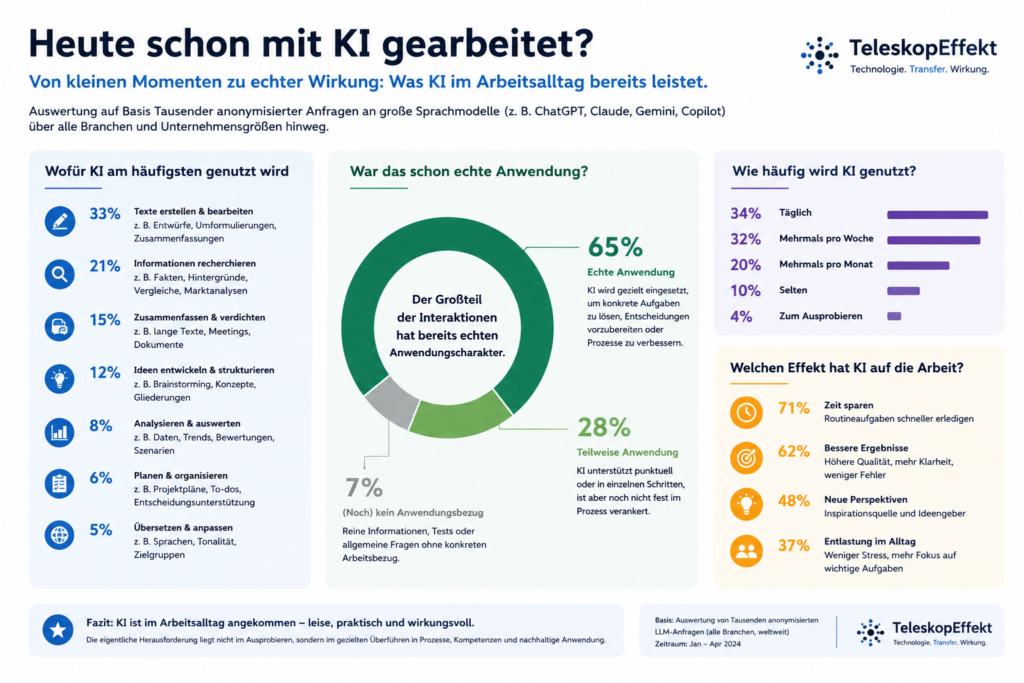
But that's exactly when the real question arises:
Was that already a real-world application? Or was it just a helpful moment to start with?
Especially when we think about the new buzzwords: AI agents, AI workflows …
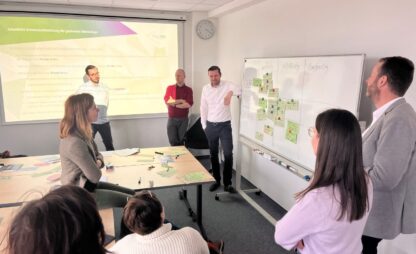
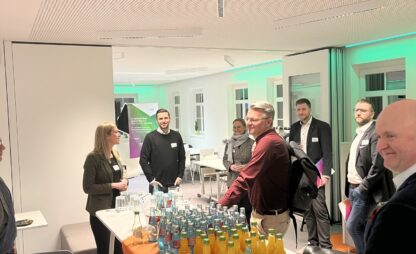
This is a question that’s currently on our minds here at TeleskopEffekt. In workshops, discussions, and innovation sessions, we’re seeing that there’s a great deal of curiosity about AI. People are starting to gain some initial experience with it. But the next step is often unclear.
What exactly are we going to do with this now? Where does the real value lie? Which processes will change? What skills will employees need? And how does an idea become a robust use case? Are the results of high quality?
For this article, we reviewed recent studies and analyses that offer different perspectives on AI usage, AI implementation, and AI expertise in companies. The Bitkom study report „Artificial Intelligence in Germany“ shows how companies in Germany assess, use, or plan to use AI, and what obstacles they currently face. The 2025 SME AI Index focuses on small and medium-sized enterprises (SMEs) and highlights how far AI adoption, piloting, implementation, and strategic planning have progressed in this sector. The study „AI Competencies in German Companies“ by Stifterverband and McKinsey examines which competencies companies need to better harness the potential of AI. The Microsoft Work Trend Index 2024 shows how deeply generative AI has already become embedded in the daily work lives of knowledge workers and where organizations still face the challenge of turning individual use into business impact. The study „How People Use ChatGPT“ by OpenAI and NBER analyzes how ChatGPT is actually being used. Particularly relevant areas include writing, information retrieval, and practical guidance. The Anthropic Economic Index provides insight into whether AI tends to act as a support or fully automates tasks.
These studies yield four insights that are particularly relevant to the adoption of AI in businesses.
Four insights that show: AI requires transferable skills.
The Bitkom study report „Artificial Intelligence in Germany“ shows that many companies view AI as an important technology for the future. At the same time, there are still concrete obstacles to its adoption, such as legal uncertainty, a lack of technical expertise, and a shortage of personnel. The 2025 SME AI Index also shows that many small and medium-sized enterprises are exploring AI, but not all of them have concrete plans or fully implemented applications yet. This makes it clear that interest alone is not enough. Companies need a practical focus. They should identify where AI can make a difference in their day-to-day operations. In processes. In communication. In decision-making. In knowledge work. In customer relationships. Or in internal collaboration.
Our assessment: AI is effective when it addresses real-world problems. A general impetus can spark curiosity. Transfer of knowledge usually occurs only when companies are able to identify and evaluate their own areas of application.
Our tip: Don't start with the tool. Start with a specific task. Ask: Where are we wasting time? Where are tasks being repeated? Where do we need a better basis for decision-making? Where is there knowledge that isn't yet being put to good use?
That's where meaningful AI applications begin.
The Bitkom study report shows that a growing proportion of companies are already using AI or are planning or discussing its use. The 2025 SME AI Index highlights the implementation gap even more clearly: Many companies are testing or piloting AI, but only a small fraction have fully implemented it. At the same time, many companies still lack concrete AI plans. This is an important insight. The hurdle is no longer just a matter of acceptance. Many companies are already open to the idea and recognize its potential. Many are experimenting with it. However, this does not automatically lead to a firmly established application.
Our assessment: There’s a big leap between „We find AI exciting“ and „AI is changing our work in meaningful ways.“ That’s exactly where we need structure, prioritization, and knowledge transfer.
Our tip: Just for the sake of curiosity, develop a simple implementation strategy. Identify three potential areas of application for AI. Evaluate them based on benefit, effort, and feasibility. Select a small-scale use case that can be tested quickly. And determine in advance how you will know if the test was successful.
This is how acceptance becomes the first step toward implementation.
The Microsoft Work Trend Index 2024 shows that generative AI has already become widely adopted among knowledge workers. Many employees have thus been using AI in their daily work for some time now. The study „How People Use ChatGPT“ by OpenAI and NBER also shows that typical uses of ChatGPT are closely linked to knowledge work. Writing, information retrieval, and practical guidance are particularly common. In short: AI is already here. Often, it starts on an individual basis. However, this only has an impact on an organization when individual applications are made visible, shared, evaluated, and integrated into collaborative workflows.
Our assessment: Many organizations have long since begun using AI. What is often missing, however, is the translation of that use into shared practice. The real question, therefore, is not just: Who uses AI? But rather: What do we, as an organization, learn from it?
Our tip: Make AI usage transparent. Ask your team: How are you already using AI? What’s working well? Where are there uncertainties? Which results have improved? Which uses should be collectively regulated, improved, or further developed?
This is how individual use becomes a shared learning process.
The study „How People Use ChatGPT“ by OpenAI and NBER distinguishes, among other things, between “Asking,” “Doing,” and “Expressing.” A large portion of usage falls under “Asking”—that is, questions, seeking guidance, clarification, and decision support. The Anthropic Economic Index aligns with this picture. It shows that AI use more often serves a supportive role than one of complete automation. This is interesting because AI is often discussed as merely an automation tool. Actual usage shows that people frequently use AI to organize their thoughts, categorize information, develop ideas, or prepare for decisions.
Our assessment: AI doesn't just replace jobs. AI changes the way people think, organize their thoughts, and make decisions. This is particularly relevant for businesses. After all, the value of AI lies not only in completing tasks more quickly, but also in asking better questions, broadening perspectives, and making knowledge more actionable.
Our tip: Use AI intentionally as a reflection partner. Don’t just let AI write texts. Let AI test assumptions, develop alternatives, identify risks, simulate customer perspectives, or structure a decision-making framework.
This way, AI is used not only more quickly but also more intelligently.
AI does not become effective simply because it is available. It becomes effective when people understand what is possible. When companies identify their own areas of application. When ideas are systematically organized. When results are documented. And when knowledge is shared across teams, organizations, and networks. That is why we view AI as more than just a technological issue. We view AI as a knowledge transfer task—from research to application; from pure technology to real-world processes; from inspiration to decision; from idea to use case; and from individual knowledge to collective learning.
That is exactly why transfer skills are needed.
For several years now, we’ve been exploring how new technologies are being put to use—in banks, in companies, in regional networks, at Werkbank32, and through innovation initiatives, learning journeys, and workshops. Our conclusion: The decisive step is rarely the first attempt at AI.
The key step is to apply it to your own context.
On our page about technology transfer, we show how technology transfer—with a particular focus on AI—can be successful. The page covers the scientific basis, methods, practical experience, and the question of how new technologies are turned into concrete applications.
Want to learn more about our expertise in knowledge transfer?