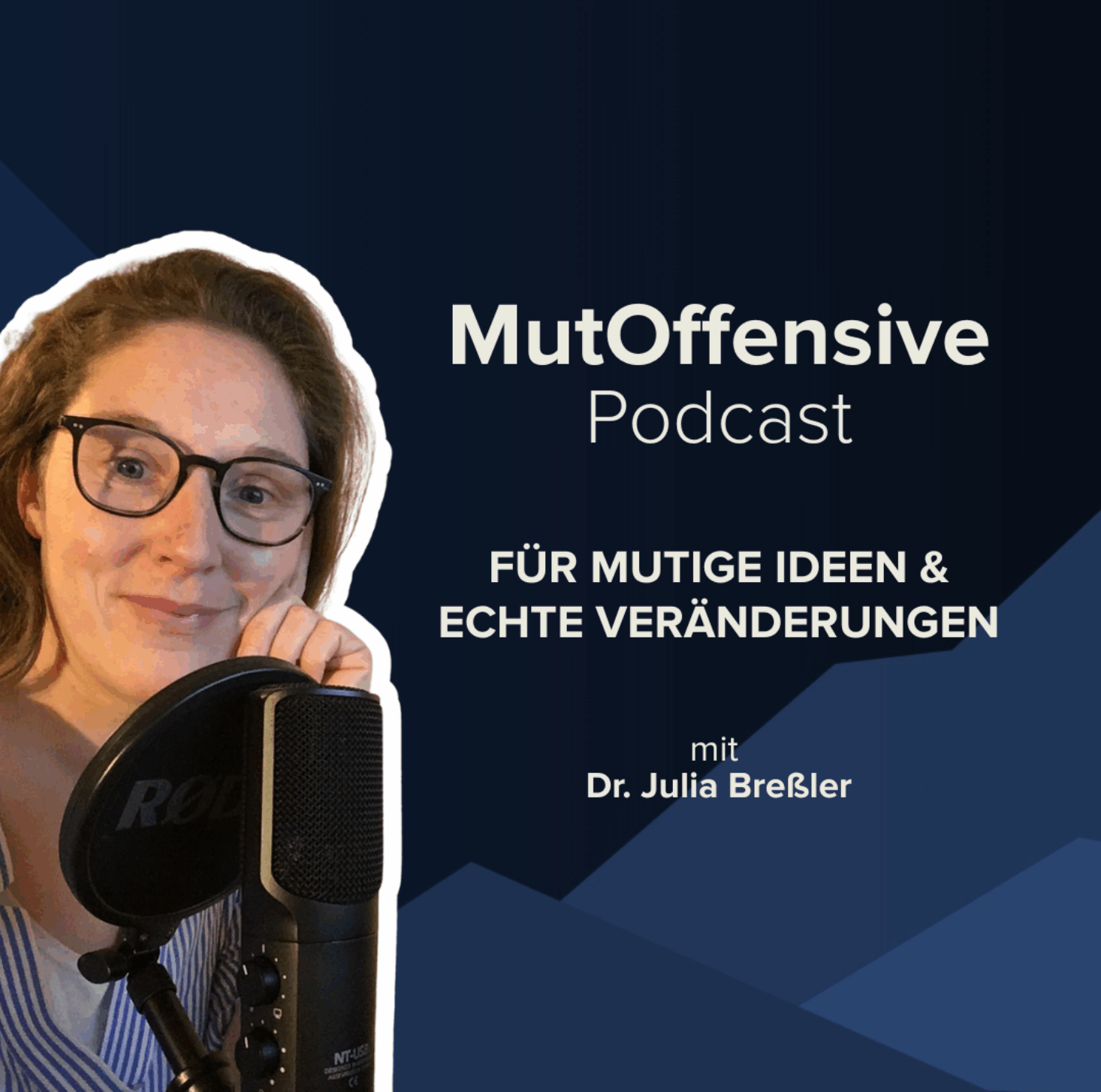
„It's about the treasure you have out there ... the many years of experience of your colleagues.“
- Dr. Julia Breßler, MutOffensive Podcast
It lies hidden in every company: a treasure that is often greater than you realize.
However, it does not consist of gold or jewels, but rather of the experience, intuition and knowledge of our employees. In short, from their knowledge. And this is the most valuable treasure.
However, this potential remains untapped in many homes, as it only becomes visible when you specifically look for it.
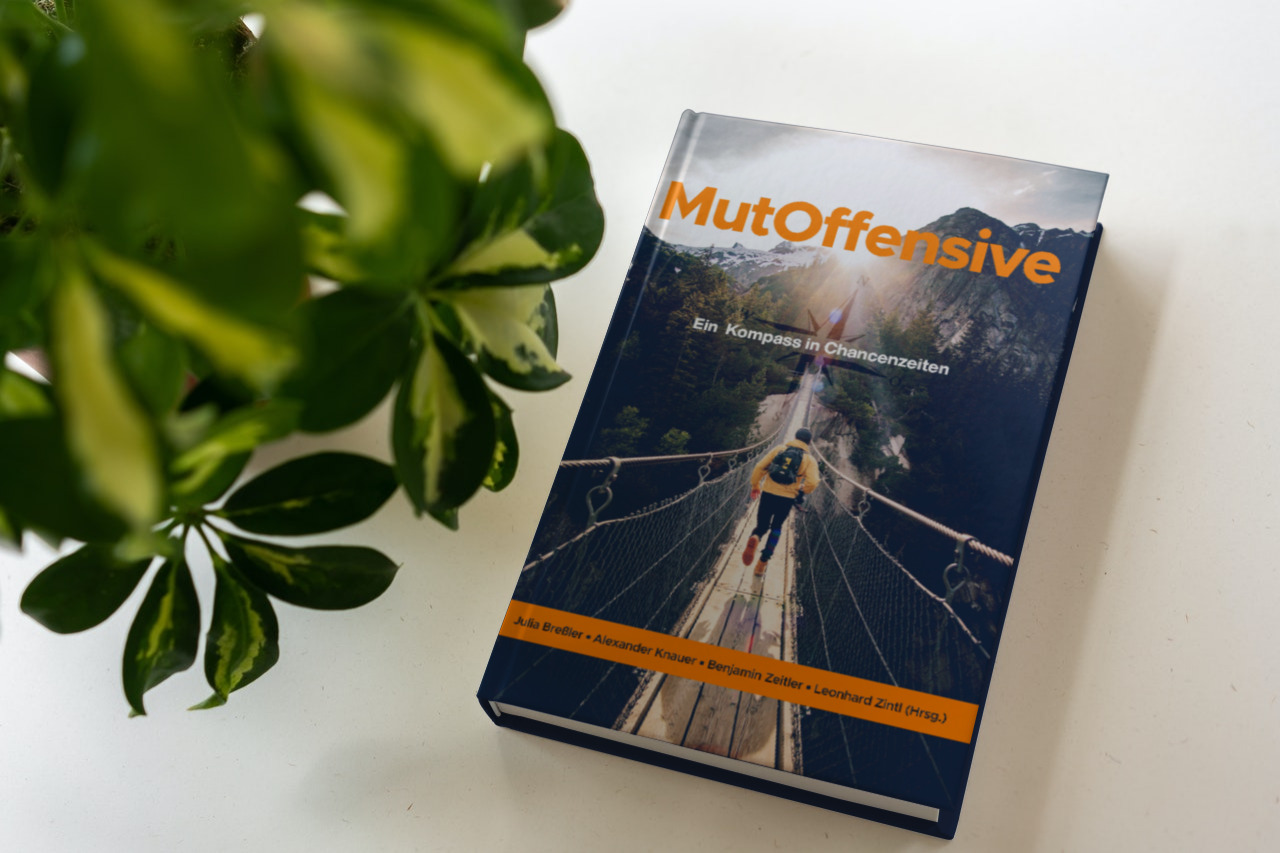
What makes this search so challenging - and how can it be successful? This is exactly what our colleague Dr. Julia Breßler discusses in the latest episode of the MutOffensive podcast together with Gabriele Herdin and Jan Foelsing. Julia holds a doctorate in innovation architecture from TeleskopEffekt and regularly produces MutOffensive to discuss current trends, exciting news and valuable ideas with different guests.
What would a real treasure hunt be without a little sea voyage? Jan Foelsing vividly explains the problem of knowledge management:
„Most of the knowledge lies below sea level, like an iceberg.“
- Jan Foelsing
Around 70 percent of knowledge in companies remains completely invisible. It is hidden in the heads of individual employees or in private chats and emails. Those who succeed in uncovering this treasure can make valuable know-how visible and usable for the entire team. This enables effective onboarding and ensures that projects can be continued even if colleagues with specialist knowledge are absent, change positions or leave the company.
If, on the other hand, this knowledge has rarely been collected, every departure of employees represents a risk (also in terms of regulation).
Gabriele Herdin emphasizes another important aspect. She describes how many employees are unable to clearly name their own experience, but intuitively do things correctly without knowing why or how exactly.
„Those who are really good often don't even know that they are good - and therefore can't pass on their knowledge.“ - Gabriele Herdin
Tacit knowledge is the most difficult part of corporate knowledge to grasp, but also the most valuable. Gabriele Herdin therefore advocates regular exchange, conscious reflection and targeted feedback loops.
Preserving knowledge is not a new challenge, but the seas have become rougher:
Jan Foelsing speaks of a veritable explosion of knowledge, which has noticeably reduced the half-life of acquired skills.
„We used to be able to put a newly learned skill into practice for 30 years. Today, it should be four to six years.“ - Jan Foelsing
Knowledge that was relevant yesterday may be outdated tomorrow. The focus of knowledge management has therefore changed significantly:
„The problem is no longer access to knowledge, but actually finding, evaluating and utilizing the relevant knowledge in a rapidly changing context.“ - Jan Foelsing
It is no longer just about storing knowledge, but about providing orientation in a constantly changing environment.
Knowledge is more dynamic, so we should use innovative technologies to filter for relevant knowledge and document it efficiently.
However, many companies still rely on rigid knowledge databases or wikis that hardly anyone maintains.
„People don't want to write long texts in wikis, and it's usually not part of their core activity. (...) Traditional documentation is simply cumbersome, it's too slow, especially for the current context.“ - Jan Foelsing
The podcast discusses the need to rethink knowledge management: away from archiving and towards continuous recording and sharing and placing knowledge in the right places (i.e. where it is needed).
However, even the best knowledge management technology cannot replace the foundation of any knowledge culture: trust. Gabriele Herdin describes how many employees are reluctant to share their knowledge. Not out of disinterest, however, but out of concern.
„Many employees go through this mentally: Do I give away my knowledge or is it better that I keep it to myself? (...) Some are worried that they will make themselves superfluous if they provide too much information.“ - Gabriele Herdin
Successful knowledge management requires the right attitude: only when companies create an open, trusting atmosphere is there a genuine willingness to share experiences and learn from one another. Modern tools such as AI can help to structure information, but for Gabriele Herdin, knowledge management remains first and foremost a cultural and leadership issue. It's about creating spaces in which people feel that their contributions are valued and not judged. What do your management tools actually look like? Do they motivate you to share knowledge or rather to hoard it in order to achieve sales figures / targets?
In the end, it becomes clear that knowledge management is not a quick adventure. It is more of an ongoing expedition. It is challenging, sometimes arduous and yet invaluable. Because those who discover, cultivate and share their knowledge treasures secure the future viability of their company.
In an interview with Gabriele Herdin and Jan Foelsing, Dr. Julia Breßler shows how complex this task is: from knowledge architectures, mentoring systems and reflection loops to digital tools that help keep knowledge alive. It takes more than just technology. It takes attitude, trust and structures that encourage people to share their knowledge.
You can find out more about this in the podcast episode: https://open.spotify.com/episode/20e9DtJK6Eg1fC9pAaXH62
You will also find many more episodes on the latest trends and innovation topics.
If you are interested in the topic and want to successfully practice knowledge management in your company, please contact our colleague Moritz! We at TeleskopEffekt have already supported numerous companies in the implementation of various knowledge management concepts.
Idea to implementation: TeleskopEffekt accompanies you
We support companies in this process, Technologies in a comprehensible, responsible and practical way to be used.