Innovation is no longer a nice-to-have, but quite simply a necessity. Artificial intelligence, changing customer expectations and the shortage of skilled workers are rapidly changing the rules of the game.
Our survey of leading bank representatives shows:
62 % of the decision-makers are convinced that innovative strength will determine the survival of their institutions over the next seven years.
A comparison of the answers from our survey shows that
There is not one understanding of innovation.
For some it means technological development, for others process optimization or new customer experiences.
Various definitions are also used in innovation research, including product, process, market and resource innovation. A distinction is also made between incremental and disruptive innovation.
None of these forms is „right“ or „better“ per se. The decisive factor is which type of innovation suits your own company. The challenge is therefore to know which tech trends or emerging ideas are relevant, what priority they should have and how to implement them sustainably. Experienced innovation management creates structure here:
It combines a strategic overview with implementation expertise and helps to distinguish short-lived hypes from real opportunities. This turns a broad concept of innovation into a precise action plan, tailored to the respective company.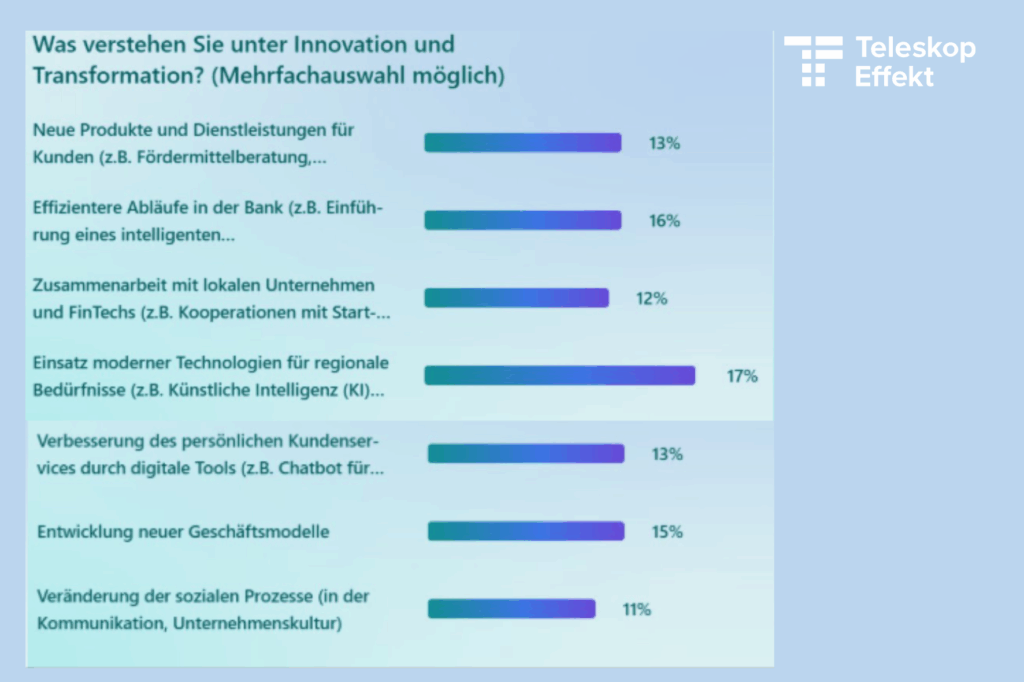
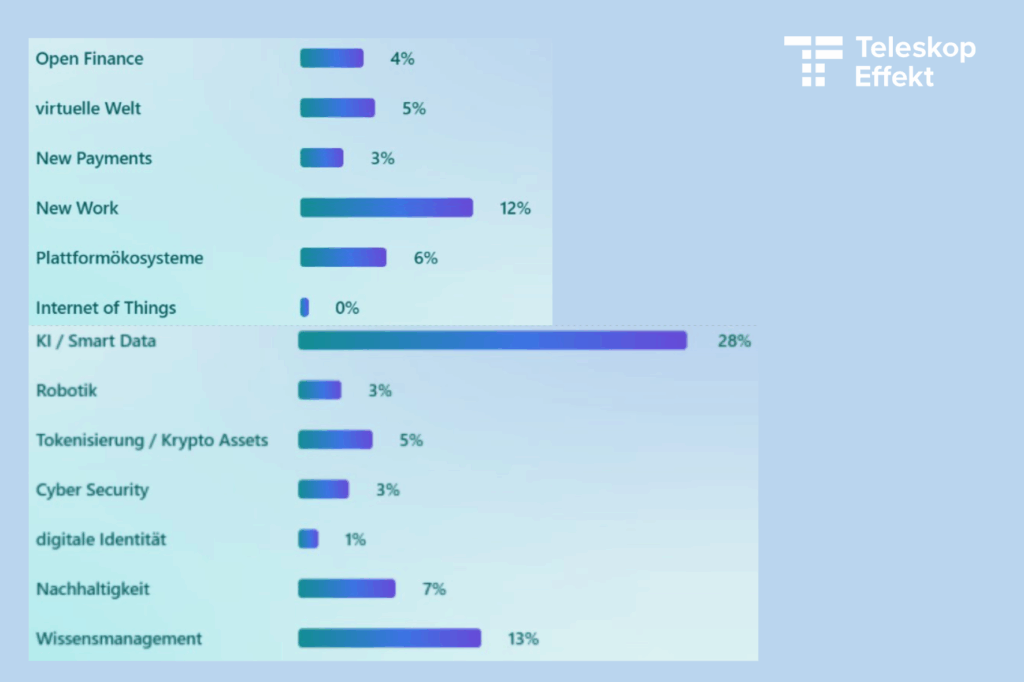
The terms that banks associate with innovation are just as diverse as the understanding of innovation itself.
In our survey artificial intelligence, New Work and Knowledge management are mentioned most frequently - topics that, on closer inspection, are at least as complex as innovation itself.
Some participants see innovation primarily in more efficient processes within the bank, others in the use of modern technologies, others in changes to social processes or the improvement of customer contact.
Completely different perspectives - and yet aspects of innovation that can be achieved through New Work. New Work is not about a specific measure or technology, but a structural change. It is about new working models, more personal responsibility, flatter hierarchies, flexible processes and teams. Here, too, there is no one way. Instead, a tailor-made strategy must be defined with a view to the company's individual goals, clearly setting out which systems are to be adapted for the company and to what extent.
As a rule, the associated terms are also mutually dependent: a modern understanding of New Work automatically promotes the exchange of knowledge through transparency, digital tools and interdisciplinary teams. This organically creates a knowledge management system that accelerates innovation. These aspects are therefore key to setting up an innovative company: individual strategy, holistic thinking and the exploitation of synergy effects.
This also applies to AI: one prominent example is ChatGPT, which already shows how differently AI can be used. However, there are also a huge number of alternative models or highly specialized AI applications that make the possibilities for using artificial intelligence seem almost endless.
At the same time, it has recently become apparent that many companies have barely been able to benefit from the use of AI, even though the technology is already being used diligently. The AI Collaboration Report 2025 from Atlassian paints an exciting picture: on an individual level, there are significant productivity gains for employees, but companies as a whole experience little increase in efficiency. Existing silo structures can be reinforced by the use of AI.
Artificial intelligence is an innovative technology, but the mere use of AI alone does not make an operational innovation. Only when technology, processes and culture work together does it develop its true added value.
This is exactly where we at TeleskopEffekt come in. We work with the St. Gallen innovation modelIt shows how companies can develop, test and successfully bring ideas to market. For us as innovation managers, it is the tool to turn creative impulses into measurable results. The process essentially comprises three steps: Idea generation, implementation and launch.
Brainstorming: Everything starts with new ideas. Whether internally by the team or externally via customers, partners or trends - we look specifically for approaches that can create real added value. Design Thinking helps to systematically develop creative solutions and focus on customer needs.
Implementation: An idea becomes a concrete concept or prototype in the implementation phase. With Rapid prototyping we test ideas at an early stage and adapt concepts iteratively through pilot projects and feedback loops. Step by step, this results in a product, service or process that really works.
Introduction: In the final step, we implement the innovation in the company. Change management ensures that innovation becomes visible, is accepted by employees and customers and has a lasting impact.
At the same time, we measure the specific benefits that an innovation brings - for example through efficiency gains, customer satisfaction or the share of sales generated by new products. This makes it clear where innovation creates real added value and how it can be further developed in a targeted manner.
With the St. Gallen approach, we not only maintain an overview of the innovation process, but can also systematically control and make measurable. Ideas are not left to chance, but are developed, tested and introduced in a structured manner - and we know exactly when and how an innovation is successful.
This structured approach makes all the difference, especially for banks that are navigating between tradition and digitalization: innovation becomes plannable, repeatable and a clear competitive advantage.
Our survey has made it clear: Innovation is not a short-term trend, but the A prerequisite for competitiveness. Technologies, customer expectations and markets are changing rapidly. WTo survive here, you need the courage to change and a clear system that steers innovation in a targeted manner and thinks holistically.
You want know how you yours Unleash innovation potential in a targeted mannerannst? Spr?me us - we support diI am happy to help turn good ideas into real impact.
Idea to implementation: TeleskopEffekt accompanies you
We support companies in this process, Technologies in a comprehensible, responsible and practical way to be used.